
Bulging Disc: When It Needs Surgery
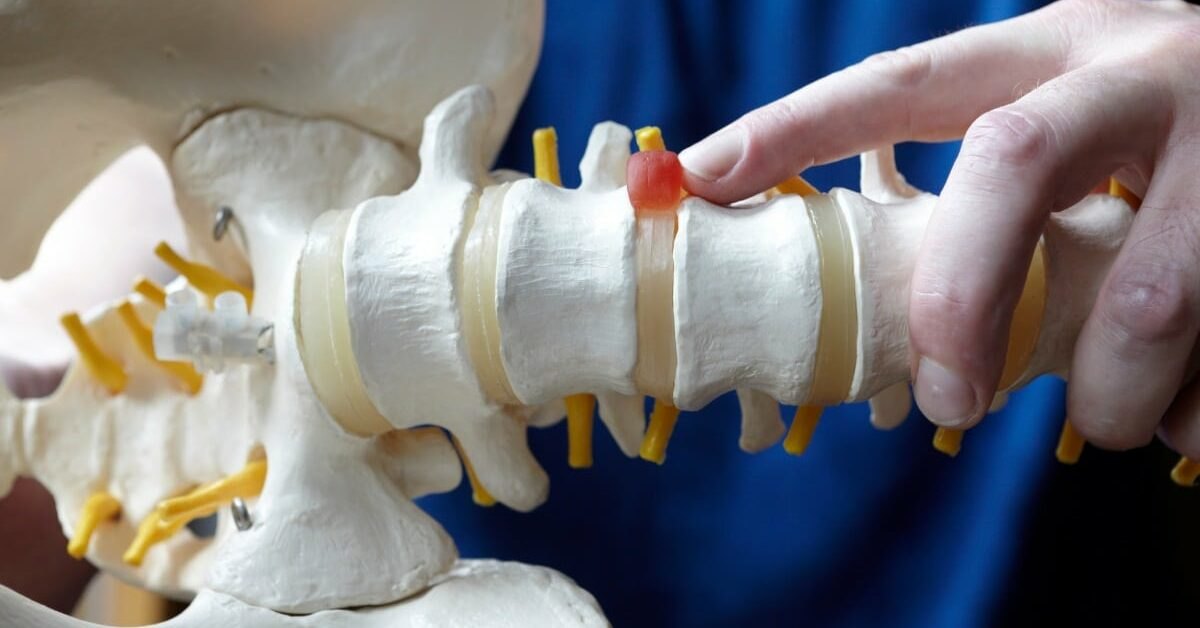
“Bulging disc” appears on a large share of spine MRI reports, including those of people with no back pain at all. It is a description of a shape, not a diagnosis of a problem — which is why the same three words can mean nothing in one person and explain everything in another.
What follows is how to tell those two situations apart, and what each one actually calls for.
What a bulging disc is
A spinal disc is a tough outer ring, the annulus, around a soft centre. With age and load the outer ring weakens and the disc spreads beyond its normal border — evenly, around much of its circumference. That is a bulge.
It matters because of what sits behind it: the spinal canal and, at each level, the nerve roots leaving the spine. A bulge only causes symptoms when it narrows the space one of those structures needs.
Bulge, protrusion, extrusion: the words on your report
- Bulge — the disc extends evenly beyond its margin. Common, often age-related, frequently symptom-free.
- Protrusion — a focal outpouching at one point. More likely to touch a nerve root.
- Extrusion or sequestration — disc material has pushed through the outer ring, sometimes breaking free. This is what most people mean by a herniated disc.
The distinction matters because it predicts behaviour: a bulge rarely progresses quickly, while an extrusion can compress a nerve hard and, paradoxically, is also the type most likely to shrink on its own over months.
The symptoms that actually point to the disc
Back pain alone tells you very little. The pattern worth paying attention to is nerve pain:
- Pain radiating down a leg, below the knee, often sharper than the back pain itself
- Numbness or pins and needles following a strip of skin rather than a whole limb
- Weakness — a foot that catches on steps, difficulty rising on tiptoe
- Symptoms worse with sitting, coughing or sneezing, which raise disc pressure
Pain in the back only, without any of these, is rarely solved by operating on a disc.
When it is an emergency
Go to an emergency department the same day if you develop:
- Numbness in the saddle area — inner thighs, buttocks, genitals
- Difficulty starting or controlling urination, or new incontinence
- Rapidly progressing weakness in both legs
This combination can indicate cauda equina compression. It is rare, and it is the one spinal situation where hours matter.
What usually works first
For the great majority of bulging discs, the first six to twelve weeks are managed without surgery, and most improve:
- Relative rest, not bed rest. Staying in motion within tolerance beats lying still.
- Physical therapy aimed at the trunk and hips, and at positions that reduce symptoms.
- Anti-inflammatories, with the usual cautions about prolonged use.
- An epidural steroid injection, when the leg pain is severe enough to block rehabilitation.
A useful principle: time and rehabilitation treat the symptoms, and in many people the disc itself quietly resorbs. Surgery is not a better version of that process; it is for the cases where it does not happen.
When surgery becomes the reasonable answer
Surgeons look for the combination, not any single item:
- Nerve pain that has persisted beyond six to twelve weeks of genuine conservative treatment
- Imaging that matches the symptoms — the compressed nerve root corresponds to where the pain and numbness actually are
- Progressive weakness, which does not wait for the calendar
- Pain severe enough to prevent sleep or work, with injections giving only brief relief
Two cautions. An MRI finding that does not match the examination is not a surgical target. And a disc that has merely been described as bulging, with back pain and no nerve signs, is usually the wrong candidate for an operation.
Which operation, and what it costs
- Microdiscectomy — removal of the fragment pressing on the nerve root, through a small incision. It is the operation for sciatica caused by a disc, and the most common one we perform on the lumbar spine. US$ 14,600 for one level.
- Disc replacement — when the disc itself has failed structurally rather than simply pressing on a nerve, and motion is worth preserving. US$ 15,200 for one disc.
- Fusion, when the segment also needs stabilising.
Every figure is published on our price list, and the full range is on our spine surgery page. Spine prices rise with the number of levels treated, which is why we quote from your MRI rather than from a category.
Frequently asked questions
Can a bulging disc heal on its own?
Symptoms resolve on their own in most people, and the disc material itself often shrinks over months. That is why conservative treatment is given a real chance before surgery is discussed.
Is a bulging disc the same as a herniated disc?
No. A bulge is a broad, even extension of the disc. A herniation is a focal rupture through the outer ring. The words are often used loosely, including in conversation with patients, but they describe different things.
Should I avoid exercise with a bulging disc?
Not generally. What should be avoided is the specific loading that reproduces nerve symptoms. Most people do better continuing to move, guided by a therapist, than resting completely.
Does the size of the bulge decide the treatment?
No. What decides it is whether a nerve is compressed, what that compression is doing to your function, and whether it is improving. Large bulges can be silent, and modest ones can be disabling.
What to do next
If leg pain, numbness or weakness has outlasted six weeks of sensible treatment, the next step is having the MRI read against your examination by someone who can act on it. Send your imaging and a description of where the symptoms actually are, and a surgeon will tell you whether an operation applies and what it would cost — in writing, before you commit to anything.