
Shoulder Injuries Athletes Ignore Too Long
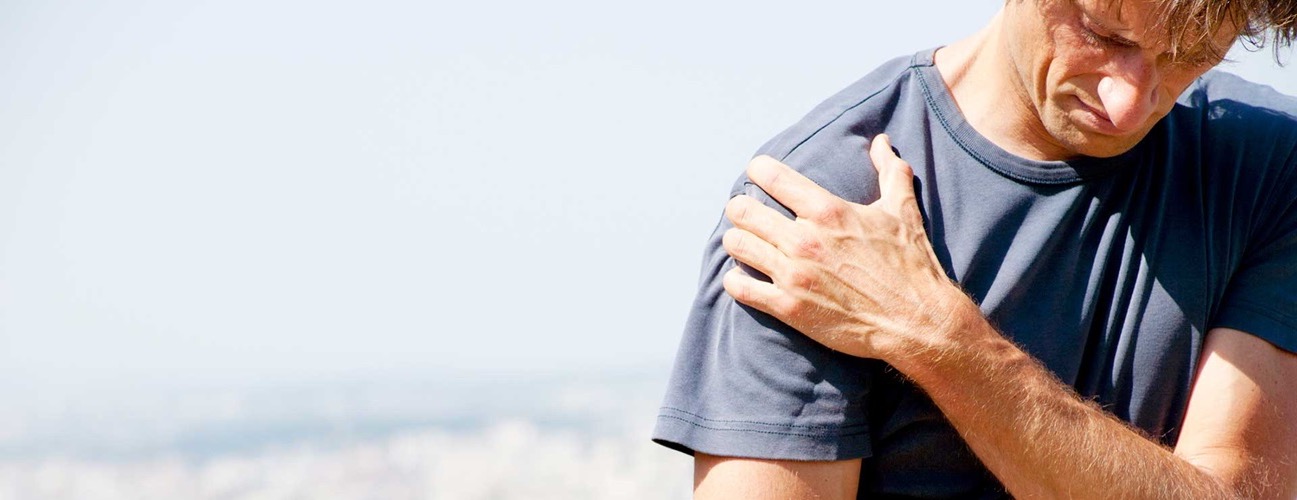
Most shoulder injuries in sport do not announce themselves. There is no moment on the field, no swelling, nothing to point at. There is a serve that hurts afterwards, a bench press that feels wrong on the left side, a night when you cannot lie on that shoulder — and a season of working around it.
Working around it is the problem. A shoulder that hurts is a shoulder you protect, and a protected shoulder loses the muscle balance that held it together in the first place. This page covers what athletes actually ignore, what it costs to wait, and how long you can reasonably wait before it stops being a judgement call.
Why shoulder pain gets ignored
Athletes are selected for the ability to tolerate discomfort. That is useful in training and dangerous in diagnosis. Three patterns come up again and again:
- It loosens up. Tendon pain often eases once the joint is warm, so the first ten minutes hurt and the session feels fine. The tendon has not improved; it has been anaesthetised by activity.
- It only hurts in one position. Overhead, or reaching behind. Everything else feels normal, so the shoulder is reclassified as fine.
- It is not the dominant complaint. The elbow or the back hurts more, because the shoulder has quietly handed them work it can no longer do.
By the time a shoulder is genuinely unusable, the injury is usually months old.
What makes the shoulder so easy to damage
The shoulder trades stability for range. A shallow socket and a large ball give you the widest arc of movement in the body, and almost none of the bony containment that protects a hip. What holds it together is soft tissue: the rotator cuff, the labrum, the capsule and the ligaments.
That means two things. Shoulder problems are usually tears rather than worn surfaces — and soft tissue under repeated load fails gradually, which is precisely why it gets ignored.
The six injuries athletes most often ignore
Rotator cuff tendinitis
What it feels like: a dull ache on the outside of the upper arm, worse after activity than during it, and worse at night.
If you wait: tendinitis is an irritated tendon, not a torn one — and it is the stage at which conservative treatment works best. Left under load, a proportion progresses to partial tearing.
Typical treatment: activity modification, a structured rotator cuff and scapular programme, sometimes an image-guided injection. Weeks to a few months, no surgery.
Rotator cuff tears
What it feels like: weakness rather than pain is the giveaway. Trouble lifting the arm overhead, or holding a weight away from the body. Night pain that wakes you when you roll onto that side is the single most common reason patients finally book an appointment.
If you wait: a partial tear can enlarge, and a full-thickness tear does not heal on its own. Over time the tendon retracts and the muscle degenerates — at which point a repair that would have been straightforward becomes difficult or impossible.
Typical treatment: partial tears are often managed without surgery. Full-thickness tears in active people are usually repaired arthroscopically. A PASTA lesion — a partial tear on the joint side of the tendon, common in throwers — has its own repair technique.
Timeline: a sling for about four to six weeks, therapy from the start, and a return to overhead sport typically measured in months rather than weeks.
Shoulder impingement
What it feels like: a sharp catch in a specific arc of movement, usually between shoulder height and overhead, often with a painful click.
If you wait: the mechanical rubbing that causes the pain also wears the tendon underneath it. Impingement that persists is one of the routes to a cuff tear.
Typical treatment: rehabilitation aimed at scapular control first. Arthroscopic decompression when a well-run programme has not resolved it.
Labral tears, including SLAP lesions
What it feels like: a deep ache inside the joint, a catching or clunking sensation, and loss of power in the final phase of a throw or a serve. Common in throwers, swimmers, volleyball and racquet players.
If you wait: the labrum contributes to stability. A tear that is left can lead to recurrent instability, and to secondary damage in the joint.
Typical treatment: SLAP repair or, in some patients, a biceps tenodesis instead. Both are arthroscopic.
Biceps tendon injuries
What it feels like: pain at the front of the shoulder, tender to press, worse with lifting or with the palm turned up. Sometimes a snapping sensation.
If you wait: a chronically inflamed long head of biceps can rupture. Some patients live with it comfortably; for an athlete it usually costs power.
Typical treatment: conservative first. Tenodesis when it does not settle, often at the same time as a cuff or labral repair.
Shoulder instability and repeat dislocations
What it feels like: the joint slipping, or the constant sense that it is about to. After a first dislocation, apprehension in the overhead position is the telltale.
If you wait: this is the injury where waiting is most clearly measurable. Every further dislocation does more damage to the labrum and, in time, to the bone of the socket. Once there is significant bone loss, a soft-tissue repair is no longer enough.
Typical treatment: stabilisation surgery, arthroscopic in most cases. Return to contact sport is usually a matter of months, and is decided by testing rather than by the calendar.
The warning signs that mean stop
Any one of these is worth an opinion rather than another week of taping it up:
- Night pain that wakes you, or stops you sleeping on that side
- Weakness — struggling with a weight you handled last month
- A dead arm during the throwing or serving motion
- The joint slipping, or catching and locking
- Pain that no longer warms up after ten minutes
- Pain lasting more than two to three weeks despite rest and load reduction
- Any dislocation, even one that reduced on its own
How long can you safely wait?
The honest answer depends entirely on which injury you have — which is the argument for finding out, not for waiting to see.
- Tendinitis and impingement: weeks of well-directed rehabilitation are the treatment, not a delay. If eight to twelve weeks of a real programme changes nothing, the diagnosis needs revisiting.
- Partial cuff tears: conservative management is legitimate, with the caveat that increasing weakness means the tear is progressing.
- Full-thickness cuff tears in an active person: the window matters. Retraction and fatty degeneration of the muscle are not reversible, and they are what turn a repairable tendon into an irreparable one.
- Instability after a first dislocation, in a young athlete: each subsequent dislocation raises the risk of bone loss. This is the situation where surgeons most often advise not waiting.
How a shoulder injury is actually diagnosed
A diagnosis is made by a clinician, with imaging as support — not the other way round. Expect three stages:
- History and examination. Which movements hurt, what you cannot do, and a set of provocative tests that separate cuff, labrum, biceps and instability. This is where most of the diagnosis is made.
- X-ray. Not to see the tendons, which it cannot, but to look at the bone: arthritis, bone loss after dislocations, calcification.
- MRI, sometimes with contrast. For the soft tissue. An arthrogram — contrast injected into the joint — is often what makes a labral tear visible.
One caution worth carrying into any consultation: MRI findings and symptoms do not always match. Rotator cuff changes are common on scans of people with no pain at all. The scan informs the decision; it does not make it.
What treatment looks like, and how long it really takes
Most shoulder problems are treated without surgery, and most of the ones that need surgery are done arthroscopically — through incisions a few millimetres wide, with less post-operative pain than open surgery.
What patients underestimate is the rehabilitation. Our own guidance is that most patients resume normal daily activities within six to twelve weeks, while a full return to all physical activity can take up to a year after a significant repair. Overhead sport sits at the far end of that range, and the athletes who get there are the ones who did the unglamorous months of scapular and cuff work.
A repair protects the tissue. Therapy is what restores the shoulder.
Returning to your sport without doing it again
Return should be earned against criteria, not a date:
- Full, pain-free range compared with the other side
- Strength within roughly 90 % of the uninjured shoulder, including external rotation
- Scapular control that holds under fatigue, not just when fresh
- A graded return to load: volume first, then intensity, then competition
- For throwers and servers: a structured interval programme, not a return to full throwing in one session
Preventing the next one
- Overhead athletes: train external rotation and the posterior cuff deliberately. Most training programmes over-develop the front of the shoulder.
- Throwers: watch total volume and rest between outings, and monitor loss of internal rotation range.
- Swimmers: technique and stroke volume matter more than any exercise you could add.
- Lifting: vary pressing angles, avoid behind-the-neck positions, and keep pulling volume at least equal to pushing volume.
- Contact sports: after a first dislocation, get a plan before the next season, not after the next dislocation.
What it costs to fix it
We publish our prices rather than quoting on request. For the shoulder, rotator cuff repair is US$ 15,000 all-inclusive, and SLAP and PASTA repairs are US$ 11,500 — one figure covering surgery, the hospital, seven nights in a partner hotel, transfers and daily follow-up during recovery. Every figure is on our price list, and the full range of procedures is on our shoulder surgery and sports injury pages.
Frequently asked questions
Can a rotator cuff tear heal on its own?
A full-thickness tear does not reattach itself. Symptoms can settle, which is not the same thing, and many people function well with an unrepaired tear. What decides the question is your age, your demands on the shoulder, and whether the weakness is progressing.
Is surgery always necessary for a labral tear?
No. Some labral tears, particularly degenerative ones, are managed with rehabilitation. Repair is more often recommended when there is instability, or when a well-run programme has not restored throwing or serving power.
How long after shoulder surgery can I play again?
Depending on the procedure, most patients are back to normal daily activities within six to twelve weeks, and a full return to sport can take up to a year. Contact and overhead sports sit at the longer end.
Does pushing through shoulder pain make it worse?
It can, and the risk is specific: continuing to load a partially torn tendon or an unstable joint is what turns a manageable problem into a structural one. Pain that warms up is not evidence that nothing is wrong.
What if my MRI was read as normal but it still hurts?
That happens, and it is not a dead end. Subtle labral and partial cuff tears are missed on standard MRI; an arthrogram often shows them. It is also possible the shoulder is not the source — the neck refers pain there convincingly.
What to do next
If your shoulder has been telling you something for more than a few weeks, the useful step is a diagnosis, not another cycle of rest and hope. Send your imaging and a short description of what the shoulder does and does not do, and a surgeon will tell you what it is, whether it needs an operation yet, and what that would cost — in writing, before you commit to anything.