
Hip Impingement (FAI): Symptoms and Treatment
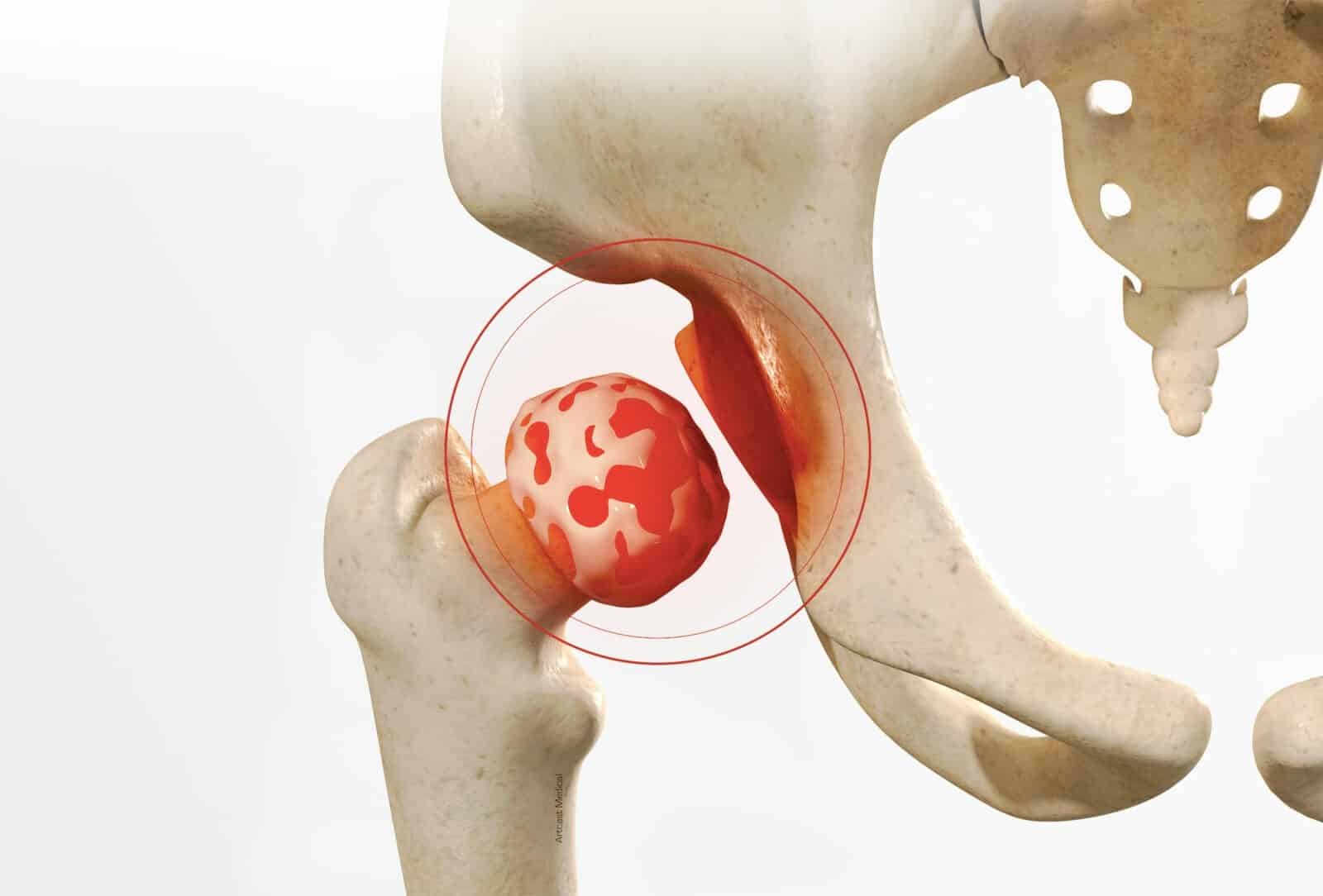
Femoroacetabular impingement, usually shortened to FAI, is the reason a thirty-year-old can have hip pain that sounds like arthritis without having any. It is a shape problem: the ball and the socket collide at the end of movement, and over years that collision damages the tissue caught between them.
It matters beyond the pain itself, because FAI is one of the recognised routes to early hip arthritis — the condition that eventually ends in a hip replacement.
What is happening in the joint
A healthy hip has clearance. The ball rotates inside the socket without the two rims meeting. In FAI, extra bone removes that clearance:
- Cam morphology. Extra bone on the head–neck junction of the femur. The ball is not perfectly round, so as the hip flexes it jams into the socket rim. More common in young men and in athletes who loaded the hip hard during growth.
- Pincer morphology. The socket covers the ball too far, so the rim makes contact early. More common in women.
- Mixed. Both, which is the most frequent finding of all.
The tissue caught in between is the labrum — the cartilage ring sealing the socket — and the articular cartilage behind it. That is the damage that produces symptoms.
What it feels like
- Groin pain, often deep, sometimes described by cupping the hip between thumb and forefinger
- Pain on sitting, especially in low seats, car seats and on a bike
- Pain with deep flexion: squats, lunges, getting out of a car
- Catching, clicking or a sharp pinch at the end of range
- Stiffness rather than instability, and a slow loss of rotation
It is typically an ache that comes with activity in the early years, and a daily problem later.
Who gets it
Cam morphology develops while the growth plate is still open, which is why it is associated with high-volume youth sport: hockey, football, basketball, martial arts, anything with repeated deep flexion and rotation. Plenty of people have the shape and no symptoms at all. The shape is not the disease; the damage it causes over time is.
How it is diagnosed
- Examination. The impingement test — flexing, adducting and internally rotating the hip — reproduces the groin pain. Loss of internal rotation is typical and easy to compare with the other side.
- X-rays. Specific views show cam and pincer morphology and, importantly, how much joint space is left.
- MRI, usually with contrast. Shows the labral tear and the state of the cartilage.
That third point decides a great deal. FAI with an intact joint surface and FAI with established arthritis are managed completely differently, and the X-ray is what separates them.
What treatment looks like
If the joint surface is intact
Rehabilitation comes first, and it is more than stretching: hip and trunk strengthening, correcting the movement patterns that drive the hip into the painful range, and adapting training volume. Many patients stay comfortable on that alone.
When it fails, the surgical option is arthroscopic reshaping of the bone and repair of the labrum. We do not perform hip arthroscopy — it is worth saying plainly rather than implying otherwise. What we treat is the stage beyond it.
If the joint has worn through
When the X-ray shows the joint space gone, reshaping the bone no longer helps: the damage is in the cartilage, not only in the collision. At that point total hip replacement is the operation that resolves the pain, at US$ 15,000 all-inclusive, and the full range of what we do is on our hip surgery page.
What happens if it is left alone
Not every impinged hip becomes an arthritic one. But cam morphology is consistently associated with the early development of hip arthritis, and the mechanism is not mysterious: repeated contact damages the labrum, the labrum stops sealing the joint, and the cartilage behind it wears faster.
The practical consequence is about timing rather than alarm. A young hip with mechanical symptoms deserves a proper assessment, because the window where the joint can still be preserved is the one that closes.
Frequently asked questions
Can hip impingement be treated without surgery?
Often, yes — particularly when symptoms are activity-related rather than constant. Strengthening, load management and technique changes resolve or control a significant proportion of cases.
Is FAI the same as a labral tear?
No, but they travel together. FAI is the shape that causes the collision; the labral tear is usually its consequence. Treating a labral tear without addressing the shape that caused it is why some repairs disappoint.
Does hip impingement always lead to arthritis?
No. Many people with cam or pincer morphology never develop symptoms. The association is real but not a certainty, which is why management is based on symptoms and on what the X-ray shows, not on the shape alone.
I am in my fifties with groin pain — is this FAI?
Possibly, but by that age the more common finding is osteoarthritis, sometimes in a hip that was shaped for impingement decades earlier. A weight-bearing X-ray usually settles the question quickly.
What to do next
If you have deep groin pain with sitting and deep flexion, the useful step is an X-ray read alongside an examination — it establishes whether the joint surface is still there, and that single fact determines everything else. Send what you have and a surgeon will tell you what stage the hip is at, and what, if anything, needs doing — in writing, before you commit to anything.